I’ve been curious about quill wheels for a while.
There are some really neat “build it yourself” wheel plans out there, like the Dodec, and more recently, the Thrifty Fox wheel.
And Majacraft even has a stylus attachment for their wheels.
But the thing is, on most of these wheels, the quill, or stylus or spindle, is pointed right back at you,,, so it doesn’t really optimized for a long draw.
And then it occurred to me-
I could mod my custom wheel to add a spindle!
And I could do it with materials that had hanging around the house.
Materials:
1 size 13 metal knitting needle.
1 straw
2 small screws
1 husband to make one cut and drill two small holes in said knitting needle.
🙂
Here is how it came together-
knitting needle inserted in wheel orifice, and secured in place with screw on the right
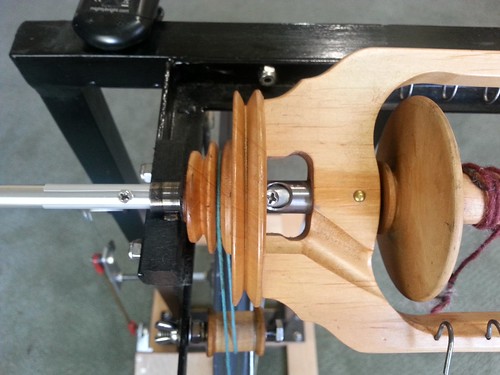
I used a slit open piece of straw as a sleeve to make it fit more snugly, so there was no wobble of the needle in the orifice.
The other screw is there only to have a place to fasten the leader yarn when you actually start to spin.
And here is the full assembly

Took a little while to get a feel for it, but it’s actually a really nice way to spin long draw, because there is no “take up” at all while you are drafting. You just draft backwards as far as you want (or can reach), and treadle until you’ve added enough twist.
Then you stop, rotate the wheel in the opposite direction to unwind the yarn back away from the tip, and then wind it onto the spindle.
Took me a couple times to figure out that if I used another straw on the spindle as a bobbin core, that it would be easy to remove the singles without having to wind off. You don’t even need to have a straw exactly the size of the spindle. Just slit the straw and pop it on there. Voila!
Here is some of my first yarn resting on a straw (sorry, all I had was a bit of clear straw left, so it’s kind of hard to see)

Cheapest bobbins ever.
Will try to shoot a little video next weekend. Probably a lot easier to follow than my description of how it works.